

Alcohol can affect your health and the way your body responds to surgery and treatment. You don’t need to totally avoid alcohol before your operation, but we would advise that you stay below the recommended low risk amounts. Start reducing the amount 6-8 weeks before surgery. If your surgery is within 6 8 weeks, start reducing as soon as possible.
The UK Government recommends for both men and women this is less than 14 units per week, with no more than 3-4 units on any single day.

3-4 units is equivalent to one and a half pints of beer, or two small glasses of wine per day only.
You should avoid alcohol in the 48 hours before your operation.
How can Alcohol impact on my Surgery and medical treatment
Drinking too much alcohol makes it harder for your body to handle the stress of surgery and increases your risk of complications.
Benefits of reducing Alcohol before your surgery or treatment
- healthier immune system
- better wound healing
- faster recovery
- less bleeding and fewer blood transfusions
- better mood, more energy
More information of the Impact of Alcohol On Your surgery
Anaesthesia and medication
Alcohol can reduce your liver function and its ability to deal with the anaesthetic drugs and painkillers used during your operation. Reducing your drinking means your liver can handle these drugs better, so you have a lower chance of experiencing any side effects like nausea and vomiting.
Delayed Healing
Alcohol can be harmful to the immune system and increase the risk of infection. This can make recovery longer. Alcohol can also interfere with the healing process after your surgery such as formation of new tissue, which is essential for healing.
Increased Risk of Bleeding
Alcohol can interfere with blood clotting, which can lead to excessive bleeding and complications during and after surgery.
Longer Hospital Stay
Patients who consume alcohol may require more monitoring and care during their recovery, which can prolong their stay in the hospital.
Alcohol free days are beneficial to your health.
Risk of complications
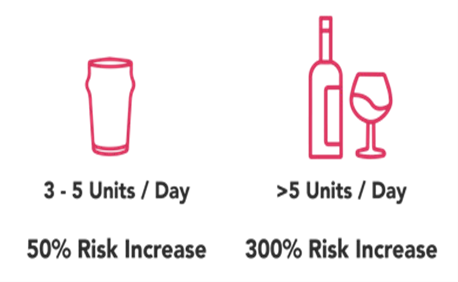
Risk of Complications:
3 – 5 Units per day = 50% Risk Increase
More than 5 units per day = 300% Risk Increase
Reducing Alcohol Before Surgery
Any amount of alcohol you cut back will help reduce the risks during surgery, but the goal should be to get down to low risk levels (no more than 14 units per week).
If you think you are drinking excessively, you should not stop suddenly. It’s safer to gradually reduce until you reach the recommended limits.
It is best to be drinking below low risk levels for at least 6 to 8 weeks before surgery to get the most benefit and reduce the risk of complications.
Top Tips
- Make a plan: set limits before drinking and stick to them.
- Set a budget for alcohol.
- Let friends and family know you are cutting down and its important to you, they can provide support!
- Take one day at a time. Cut back a little each day and make every day you do a success.
- Drink a glass of water before you have alcohol.
- Try alcohol free drinks or a selection of mocktails.
- Drink smaller measures or lower alcohol alternatives, swap strong beers or wines for ones with a lower strength (ABV in %).
- Make every other drink a glass of water or a soft drink.
- Have several alcohol free days every week.
How much am I actually drinking?
Units are a way to describe the quantity of pure alcohol in a drink. The number of units in a drink can vary depending on the bottle or glass size as well as the strength of the alcohol.
| Alcoholic drink type | Alcoholic units |
| 1 Pint of beer, lager or cider at 4% ABV | 2.2 units |
| A 330ml bottle of beer, lager or cider at 4.5% ABV | 1.5 units |
| A 175ml glass of wine at 12.5% ABV | 2.2 units |
| A 250ml glass of wine at 12.5% ABV | 3.1 units |
| A 750ml bottle of wine at 12.5% ABV | 9.8 units |
| A 25ml measure of spirits at 40% ABV | 1 unit |
Public Health Scotland
More information about alcohol units can be found here: https://www.nhsinform.scot/healthy-living/alcohol/how-does-my-drinking-add-up/
Count14 Website: Helps people calculate how much they are drinking and offers advice https://count14.scot
Support for Cutting Down
- Speak to your GP and ask for local services which may include counselling.
- ECLA Counselling Service: Offers help to people worried about their drinking or someone else’s. They provide drop-in services, advice, and one-on-one counselling. ELCA Counselling Service
- Pre assessment clinic: Be honest about the amount you drink as this will help staff care for you. They can give you help to reduce and make sure you are prescribed the correct amount of medication.
- You can find further information on the NHS Inform website. https://www.nhsinform.scot/healthy-living/alcohol/
- Drink aware: https://www.drinkaware.co.uk
- Advice for heavy drinkers Advice for heavy drinkers who are thinking about cutting back or stopping drinking alcohol – Scottish Health Action on Alcohol Problems
Alternatively, you can self refer to your local service directly depending on where you live within the Lothian area.
Edinburgh
- Edinburgh Alcohol and Drugs Partnership. Edinburgh Alcohol and Drugs Partnership – Supporting Drug and Alcohol recovery in Edinburgh
West Lothian
- West Lothian Drug and Alcohol Partnership 01506 282845
- WLDAS (West Lothian Drug and Alcohol Service) 01506 430225 or WLDAS | Home
Midlothian and East Lothian
- Midlothian and East Lothian Alcohol and Drugs Partnership 0131 653 5162 or MELDAP