

Here you’ll find information about who runs the clinic, what to expect at your appointment, how to prepare, and what usually happens afterwards.
Who runs the clinic?
Our Gynaecological Oncology Clinic takes place in the Gynaecology outpatient department at the Royal Infirmary of Edinburgh. Some appointments may also be offered by video or telephone, and occasional clinics are held at St John’s Hospital in Livingston. Please check your appointment letter carefully for details of location and format.
Our service is delivered by a team of specialist consultants, doctors, clinical nurse specialists, and experienced nurses who care for women with cancers of the cervix, ovary, womb (uterus), vagina and vulva. We also work closely with colleagues in radiology, pathology, medical oncology and radiotherapy to make sure every patient receives coordinated, personalised care.
If your symptoms or investigations suggest involvement of other areas such as the bowel or urinary system, we may involve our colorectal or urology colleagues to support your care.
What will happen at my appointment?
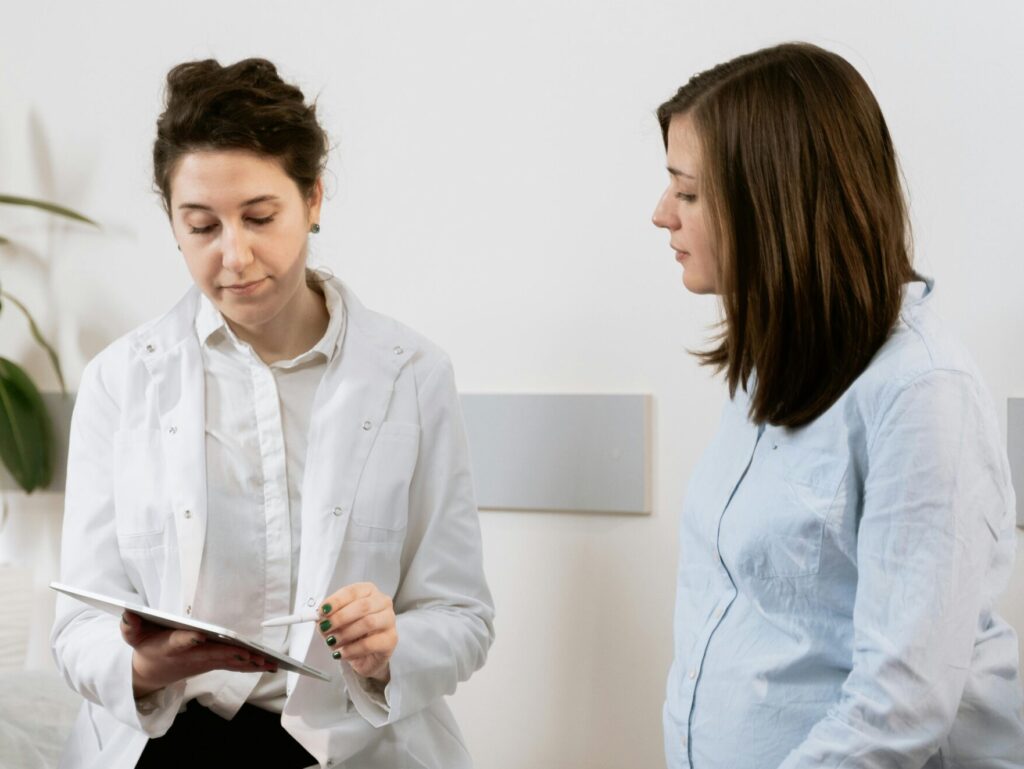
A member of our Gynaecological Oncology team will talk through your symptoms, previous tests and treatments, and how any concerns you have are affecting your daily life. This helps us understand what further investigations or treatments you may need. A physical examination is often useful. With your permission, this may include examining your abdomen (tummy) and pelvis (vagina). A trained chaperone will always be present. You will have complete privacy when undressing and getting dressed again.
Diagnostic tests may be arranged based on your symptoms and exam findings. These may include:
- Blood tests
- Imaging such as a CT scan
- Biopsies (whereby a small piece of tissue is taken for analysis)
Sometimes more specialist investigations, such as cystoscopy (a bladder camera test) or sigmoidoscopy (a bowel camera test), are required. If so, we will arrange separate appointments and make sure you know exactly what to expect.
You may also be invited to meet our pre-habilitation team who will give you exercieses and and tasks that will help you maximise your fitness for treatment. This is an important appointment, and you are encouraged to bring someone with you for support. Writing down questions in advance can help you get the most from the discussion. You may also meet your Clinical Nurse Specialist, who will remain a key point of contact throughout your care.
What will happen at my pre-operative appointment?
If surgery is recommended, you will usually be invited to a pre-operative appointment. At this visit, a member of the Surgical Gynaecological Oncology team will:
- Go over the results of your tests and scans again
- Confirm the planned operation and why it is recommended
- Discuss alternative options, where appropriate
- Explain the benefits, risks, and expected recovery
- Answer any questions you may have
What will happen at my anaesthetic assessment?
Most patients will have an anaesthetic assessment before surgery. This may be with a specialist nurse, an anaesthetist, or both. The purpose of this appointment is to make sure you are as safe and well-prepared as possible for surgery. This assessment may include:
- Reviewing your medical history and medications
- Checking blood pressure, heart rate, and breathing
- Blood tests or other investigations if needed
- Discussing previous anaesthetics and any concerns
The anaesthetic team will talk to you about the type of anaesthetic planned and how pain will be managed after surgery. This may include spinal or epidural anaesthesia, patient-controlled pain relief, or tablets.
Will I need to come into hospital before surgery?
Some patients are admitted on the day of surgery, while others may be admitted the day before. You may be asked to come in earlier if:
- You live a long distance away
- You need medical optimisation before surgery
- You require treatments such as iron infusions or, occasionally, a blood transfusion
- Your team will explain clearly what applies to you and why.
Bowel preparation
Some operations require bowel preparation, while others do not. If bowel preparation is needed, you will be given clear written instructions. This may involve:
- Changes to diet
- Laxatives or bowel-cleansing drinks
- Instructions about when to stop eating and drinking
- If bowel preparation is not required, we will tell you this clearly. Please do not start bowel preparation unless advised to do so by your clinical team.
You can expect:
- On the morning of surgery, you will be cared for by the ward nursing team and surgical team.
- You will meet the nursing staff looking after you
- A final review of your medical details
- Confirmation of your consent
- Opportunity to ask any last questions
- You will meet members of the team involved in your surgery, which may include:
- Your surgeon or surgical team
- The anaesthetist
As a teaching hospital, medical students may be present. If you are uncomfortable with this, please let us know. You will then be taken to the operating theatre area, where the team will explain what will happen next before your procedure begins.
Surgery and robotic surgery
We offer a range of highly specialist procedures, including keyhole (laparoscopic), robotic and open surgery. Your consultant will discuss which type of operation is most suitable for your condition.
At NHS Lothian, we are fortunate to offer robotic-assisted surgery as part of our range of surgical treatment options for selected gynaecological conditions, including cancer. This technology is part of a wider national and international shift toward safer, more precise, minimally invasive surgery.
Robotic surgery is a form of keyhole (minimally invasive) surgery that enables surgeons to perform complex procedures through small incisions with enhanced precision and control. It is not better or worse than key hole surgery without a robot.
For more information from a surgical standards perspective, you can visit the Royal College of Surgeons of England’s page on robotic surgery here: https://www.rcseng.ac.uk/standards-and-research/future-of-surgery/robotics/
What robotic surgery is
Robotic surgery uses computer-enhanced instruments and a high-definition three-dimensional camera to help your surgeon operate through small keyhole incisions. The robotic system translates the movements of your surgeon’s hands into precise movements of surgical instruments inside your body.
The robot itself does not perform surgery independently; your surgeon remains in full control throughout the procedure.
Why robotic surgery may be used
Robotic surgery is one of several surgical approaches and may be recommended when it offers benefit compared with traditional open or standard keyhole surgery. Potential advantages of robotic surgery include:
Potential advantages of robotic surgery include:
- Smaller incisions and less tissue trauma
- Greater precision and control for complex maneuvers
- Reduced blood loss during surgery
- Lower risk of needing to convert to open surgery in complex cases
- Less post-operative pain and scarring
- Shorter hospital stay and potentially faster recovery
These benefits are really only evident in complex procedures where enhanced instrument dexterity and visualisation can help the surgeon perform delicate dissection in confined spaces.
Your surgical team will explain whether robotic surgery is appropriate for you based on your diagnosis, overall health, and the specific surgical goals. You can choose to explore other surgical options if you prefer.
What to expect
Before the operation, your surgeon will discuss:
- Why robotic surgery is recommended for your situation
- The benefits and risks compared with other surgical approaches
- What preparation is required before your surgery
You will be given time to ask questions and consider your options. If you have concerns about the surgical approach, your team will discuss suitable alternatives with you.
During surgery
You will be cared for in a fully equipped operating theatre with your anaesthetic and nursing teams. Your surgeon remains in the room at a console and controls the robotic instruments throughout the procedure.
After surgery
Recovery from robotic surgery and traditional key hole surgery is often quicker than after traditional open procedures, but your individual experience will vary. Early mobilisation, pain management, and follow-up care will be tailored to your needs. Your care team will provide guidance on activity, diet, wound care, and signs to watch for as you recover.
Safety and training
Robotic surgery is safe and effective when used appropriately by trained teams. Implementation of robotic surgery in the UK follows principles of robust training and governance to support safe, high-quality care.
Your surgeon and theatre team are trained and accredited to use robotic systems, and quality assurance processes are in place to ensure the highest standards of care.
Why NHS Lothian offers robotic surgery
NHS Lothian is one of the centres in Scotland with access to robotic surgical systems, enabling our specialists to use advanced technology to enhance patient care. Offering robotic surgery reflects our commitment to evidence-based, patient-centred care and supports improved recovery and outcomes where this approach is appropriate.

Questions you might want to ask
- Why is robotic surgery recommended for me specifically?
- What are the alternatives and how do they compare?
- How long might my recovery take?
- Who will be in the operating theatre during my procedure?
- What support will I receive after surgery?
Your care team is always available to discuss these and other questions — please do not hesitate to ask
After my surgery
After surgery, you will be cared for in a recovery area before returning to the ward. Some patients may require care in a higher-dependency area; if this is likely, it will be discussed with you in advance.
It is common to have:
- A urinary catheter
- Intravenous lines for fluids and medications
- Monitoring by specialist nursing staff
Your recovery plan will be individual to you. General measures that often help recovery include:
- Gentle movement as soon as it is safe
- Sitting out of bed and walking short distances
- Eating little and often
- Drinking regularly
- Breathing exercises if advised
- Chewing sugar-free gum to help bowel recovery after abdominal surgery
Pain relief will be tailored to your needs. Please let your team know if pain is not well controlled — this is important for recovery.
When will I go home?
You will be discharged when it is safe to do so and when you are comfortable managing at home. Before discharge, your team will:
- Your Clinical Nurse Specialist will often remain involved after discharge to support you.
- Review pain control and medications
- Give advice about wound care and activity
- Provide contact details if you have concerns after leaving hospital
Follow-up after surgery
Tissue removed during surgery is examined by specialist pathologists. These results often take several weeks and are discussed at a multidisciplinary team meeting. You will be given a follow-up appointment to:
- Discuss the pathology results
- Understand what they mean for your diagnosis
- Review your recovery
- Discuss whether any further treatment is recommended
This appointment is an important opportunity to ask questions and plan the next steps together. Sometimes this appointment is done over the telephone if that is appropriate and you are happy with this method.
Chemotherapy or Radiotherapy
Some patients may need treatments like chemotherapy or radiotherapy, which will be explained in detail and planned carefully by the Clinical Oncology and Medical Oncology teams at the Edinburgh Cancer Centre, based at the Western General Hospital.
Multidisciplinary Discussion (MDM)
If your diagnosis or treatment is complex, your case may be discussed at our Gynaecological Oncology Multidisciplinary Meeting. This is where surgeons, oncologists, radiologists, pathologists and specialist nurses review your results together to decide the safest and most effective plan of care. You won’t attend this meeting, but your consultant will explain the outcome to you.