
What are the main treatments in bronchiectasis?
In most cases treatment involves three basic elements:
- Regular chest clearance to remove sputum and improve symptoms
- Avoidance of chest infections
- Prompt antibiotics for chest infections
Does everybody need the same treatment?
No – because there are different causes and levels of severity of bronchiectasis and so the treatment planned for you will depend on the cause and severity of your condition.
Some patients have very mild disease and they do not always cough up sputum and only have very few chest infections. Patients with more severe bronchiectasis may have symptoms all the time producing large volumes of coloured sputum and often experience frequent chest infections.
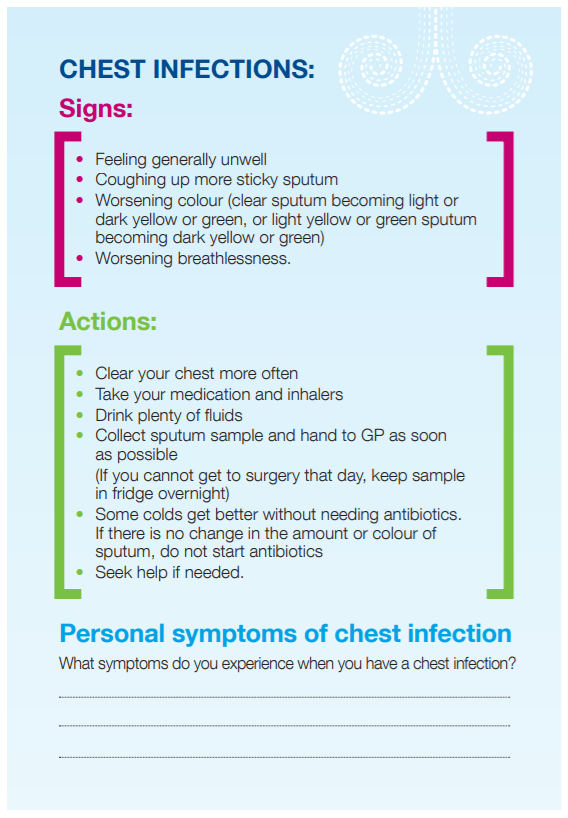
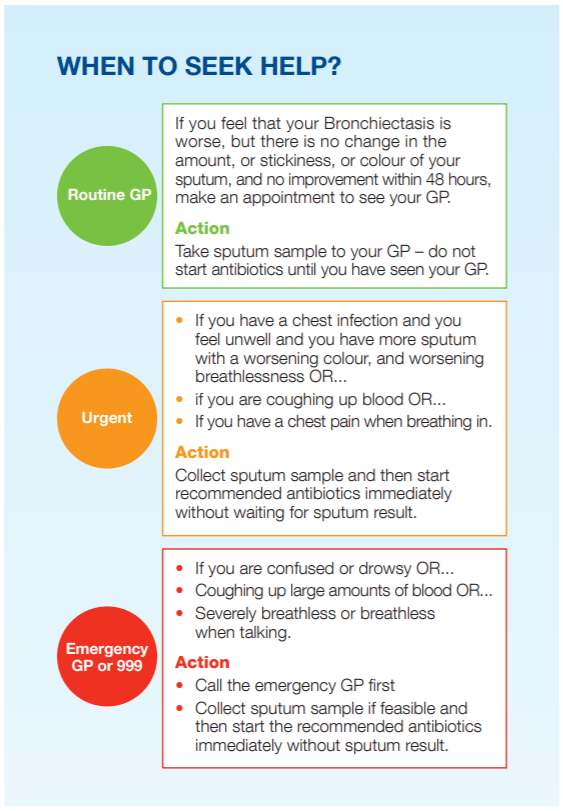
Personalised self-management plans are very useful in aiding patients to manage their symptoms, manage exacerbations (chest infections) and when to seek help.
How are chest infections (exacerbations) treated?
As part of your individual treatment plan we will recommend the specific antibiotic, dose and duration you should take when you have a chest infection.
For all chest infections it is advised that a sputum sample be handed into your GP and then to start antibiotics as soon as possible.
DO NOT WAIT for the sputum results to come back which can take several days. The reason why you are asked to hand in a sputum sample is because chest infections can be caused by different bacteria (bugs). Further tests are then done to identify the best antibiotic/s to treat the bacteria.
If your symptoms have improved with your recommended antibiotic there is usually no need for you to change to a different antibiotic even if you have grown a different bacteria on that occasion.
Most infections are treated with tablets you take by mouth but in some cases we recommend you receive antibiotics directly into your veins (intravenous treatment). This intravenous treatment may be needed because you are very unwell or because of the specific bacteria that has grown from your sputum sample.