

We all produce sputum (mucus/ phlegm) in our airways. This is important to keep the airways moist, and stop unwanted particles going further into the lungs.
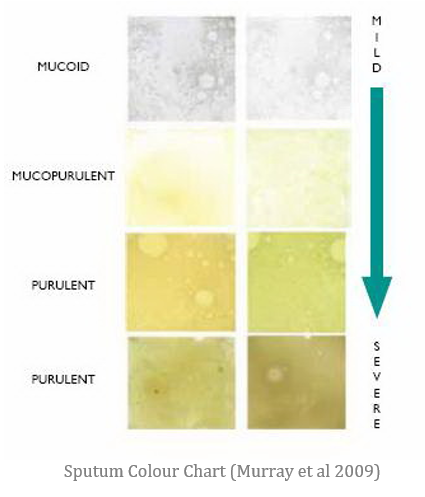
In bronchiectasis the airways are widened and more sputum is produced which can be difficult to clear, putting you at more risk of a chest infection. A cough productive of sputum is one of the main symptoms of the condition.
The sputum produced can widely vary between individuals. It is useful to know how much sputum is usual for you, as well as the usual colour and consistency.
Changes in any of these such as increasing volumes of sputum or sputum that is darker in colour than your norm can be an indication that you are having an exacerbation.
This is the time to hand a sputum sample into your GP practice so it can be tested and make sure you are on the most appropriate antibiotics.
Try to hand in your sample early in the day if you are able. If you produce your sputum sample in the evening then keep this in the fridge and hand it in the following morning.
It can be helpful to bring a sample of sputum to your clinic appointment as well.
What about sputum colour?
Broadly the darker the colour (yellow/green/brown), the greater the level of infection. However, quite dark sputum colour can be produced even when there is no infection in patients with more severe bronchiectasis. Colour charts for sputum (see opposite) are used by the doctors.
What about sputum volume?
Larger volumes tend to be an indicator of greater levels of infection. However, quite large sputum volumes can be produced even when there is no infection in patients with more severe bronchiectasis.
A physiotherapist can teach various methods to help you clear sputum and reduce the risk of infection. This is something you should continue independently and add into your daily routine. Please see our page Physiotherapy within the treatment section of this website.