

Hearing loss is common and affects around 12 million people in the UK. It can range from mild to profound and can affect one or both ears and can result from various causes, such as aging, exposure to loud noise, infections, earwax build up, genetics, or medical conditions. These are different types of hearing loss.
Sound waves enter the ear canal to the eardrum, where they make the eardrum vibrate.
The vibration/sound wave passes from the eardrum to the inner ear, across the middle ear space, by vibrating the chain of the three tiny connected ear bones.
The sound waves then travel to the cochlea in the inner ear where the vibrations are converted to a signal. This signal is then transferred along the auditory nerve to the brain
Our brains interpret the nerve signal as sound.
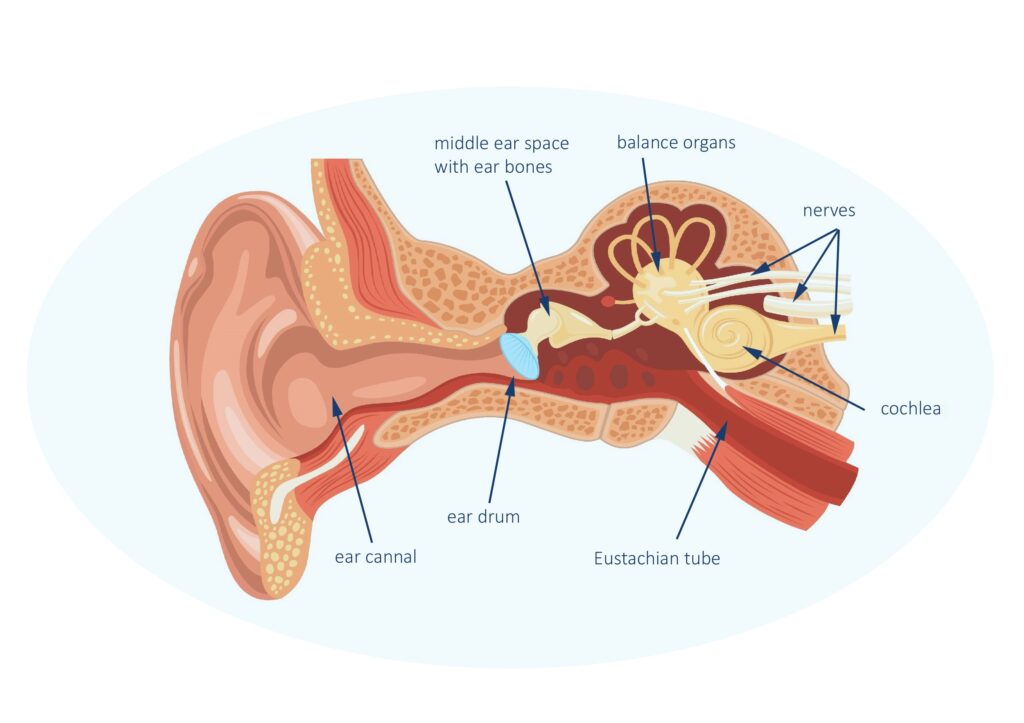
Conductive loss – occurs when something is preventing the sound wave from reaching the cochlea in the inner ear. This can be due to blockages in the ear canal. Alternatively, the eardrum or middle ear space may have become damaged, or congested.
Sensorineural Loss – occurs when there is an issue in the cochlea or the auditory nerve. This is often caused by aging or noise exposure, and can occur gradually, so people often do not realise that their hearing is getting worse in most cases. High pitched sounds are more likely to be affected than low pitches. This type of hearing loss reduces the quality of the sound, clarity of speech, as well as it’s loudness.
Mixed Loss – is a combination of conductive and sensorineural hearing loss.
A common assumption once we are aware of hearing loss in one or both ears is that our hearing is deteriorating quickly. Thankfully this tends not to be the case. Luckily for the majority of us, our hearing deteriorates very gradually over the years. Hearing tests carried out three-five years apart tend to show marginal changes in our hearing.