
Page Menu
(click on a title to go directly to that section)
- Welcome to the Stroke Page for Care Homes – what this page is, how it was developed and the thinking behind it
- Introduction to Stroke
- Quick Reads – Initial Information
Welcome to the Stroke Page for
Care Homes!
This page contains information on Stroke and details of education sessions available on Stroke.
Many of the materials on this page have been specifically designed for Care Homes, as we appreciate you may care for someone at any stage of their stroke journey, from the initial acute stage of having a stroke through to caring for someone immediately after or even years after their stroke.
- Person-centred approach – we don’t just focus on physical symptoms of initial stroke but other areas that may be affected for years after, including: emotions, communication, sight/perception and other aspects.
- Whole home approach – staff may vary in their knowledge and skills in relation to stroke, so a tiered (step-by-step) approach is used for education. Furthermore, all staff roles can receive education because many staff have contact with residents outwith caring roles, i.e., maintenance, housekeeping, managers, office staff, etc.
This page and the materials on it were developed through a collaborative quality improvement (QI) project between the NHS Lothian Stroke Team, Care Homes and NHS Lothian’s Quality Improvement Team for Care Homes and Primary Care Settings.
Read more about the project to develop these materials
The quality improvement project to develop these resources started after reflective discussions around how suitable the present stroke education was for people working in Care Homes and that NHS stroke education was seldom accessed by Care Homes; there was a desire to ensure Care Homes had access to stroke education that suited their needs.
We spoke to Care Homes about what they would like to see in relation to stroke education for Care Homes – there was a desire to include not only acute and rehabilitation phases of a stroke but also caring for someone with a stroke longer term; something which is particularly relevant to people working in a Care Home where they may care for someone with a stroke many years after the person has experienced their stroke. There was also a desire for a mixture of resources from online learning to in-person learning.
From this, we developed a stroke education package of online resources and in-person education. We tested this with four Care Homes in Edinburgh to gain initial feedback. Overall feedback was very good with a few small changes required, such as different sessions for different staff roles, as some roles already have some educaiton on stroke, but others don’t.
Following this, we tested the stroke education package (with changes made in relation to previous feedback) on a wider scale with more Care Homes; across the four areas of Lothians and with a wider variety of “types” of Care Homes (i.e. Private, Charity, Local Authority). Again, overall feedback was very good, and the changes we made appeared to have been beneficial to learners.
From this, we have decided to roll out this information and education package across Care Homes in Lothian, so that everyone can access it. Initially, we will still collate feedback to ensure the materials meet your needs.
More detail
We have developed the following resources to evidence our work. Please feel free to read them to find out more about the ins and outs of how we created this education package
Poster
We’ve created a poster of the pilot project so far. This was displayed at the UK Stroke Forum 2025 in Aberdeen.
Please view our poster from the UK Stroke Forum 2025, Evaluation of a stroke education programme for staff from four Care Homes in Lothian
Project Report
Coming soon!
Introduction to Stroke
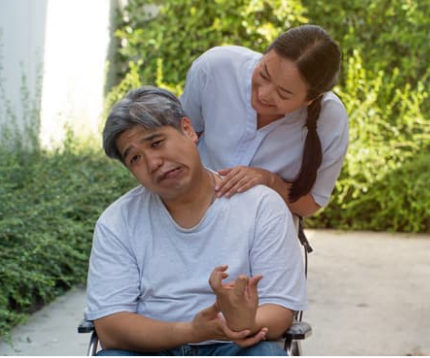
Stroke is one of the leading causes of disability in the world and frequently results in changes to people’s ability to move, talk, and think.
Approximately, 10, 000 people each year in Scotland will have a stroke. In Lothian, approximately 1, 400 people each year will have a stroke.
Recovery is variable, and many people will continue to require adaptation or assistance to participate in their daily living activities.
Some people who require 24- hour assistance may move into a Care Home. As stroke is more prevalent at an older age a Care Home resident may be more at risk of having a stroke than a younger person.
We want you to feel confident and skilled when working with people who have experienced a stroke which is why we have developed this page and resources for you!
Quick Reads – Initial Information
- Stroke Information for what to do if someone is having a stroke, what a stroke is, the different types and expected treatment.
- Correct positioning for someone who has experienced a stroke.
- Moving and positioning equipment for someone who has experienced a stroke.
- Resources to help you understand specialist stroke words and terms and abbreviations (letters)
Videos
A variety of videos on various topics from types of stroke to complications after stroke.
Care Home Education Sessions
Tiered model of education
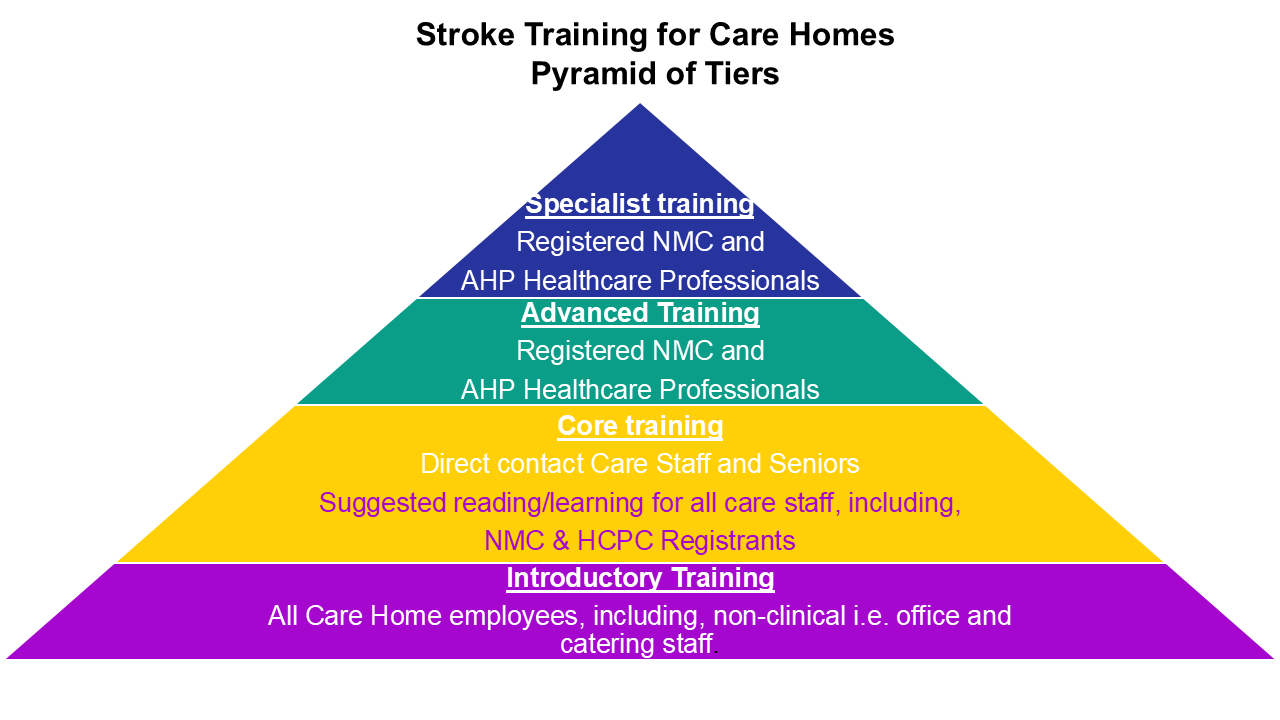
Due to feedback from the project to develop these materials and education, Care Home stroke education is delivered via a stepped (tiered) model so that staff can build up their stroke knowledge and skills in each step (tier) of education before moving on to the next tier, if they wish to do so.
Additionally, we found during the development of these stroke education materials that different staff roles, at times, had different learning needs, and the tiered model aims to work with these differences and ensure everyone can receive stroke education relevant to them.
The first two tiers of the model are Care Homes specific, where a one-hour introductory session and an all-day session are on offer, whilst the other tiers on offer are for a range of staff from different areas of healthcare, including Care Homes.
Pyramid of Tiers
Tiered Courses and Learning
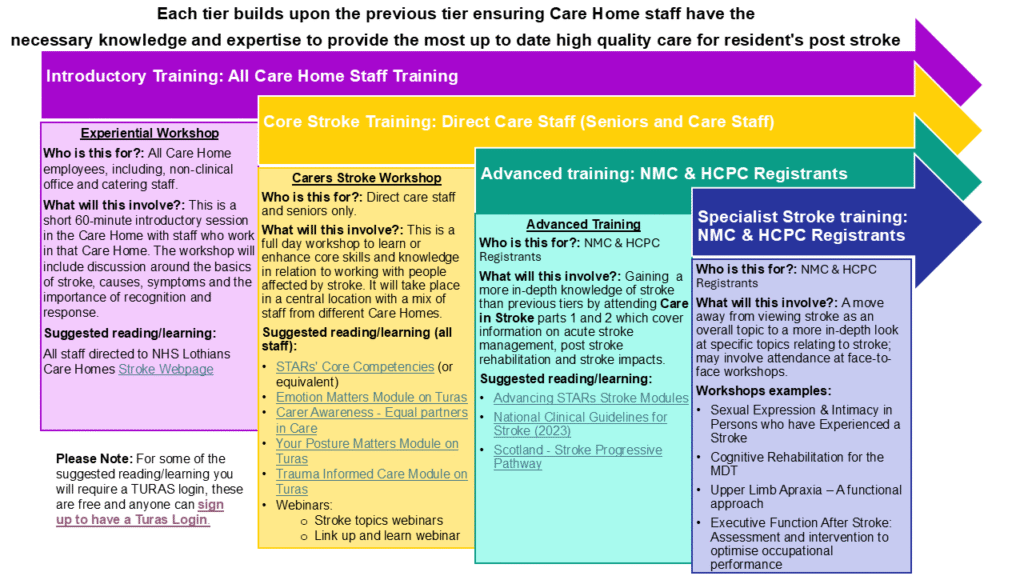
NHS stroke education and resources are available to Care Home staff, but there are two specific sessions that have been specifically developed for Care Homes; these are discussed below.
Please view the tiered model information above, which explains the rationale behind different areas and different staff roles having different education, and please view the section Other Education Available to view education sessions available to staff from different areas of healthcare, including Care Homes.
1 Hour
Experiential Workshop
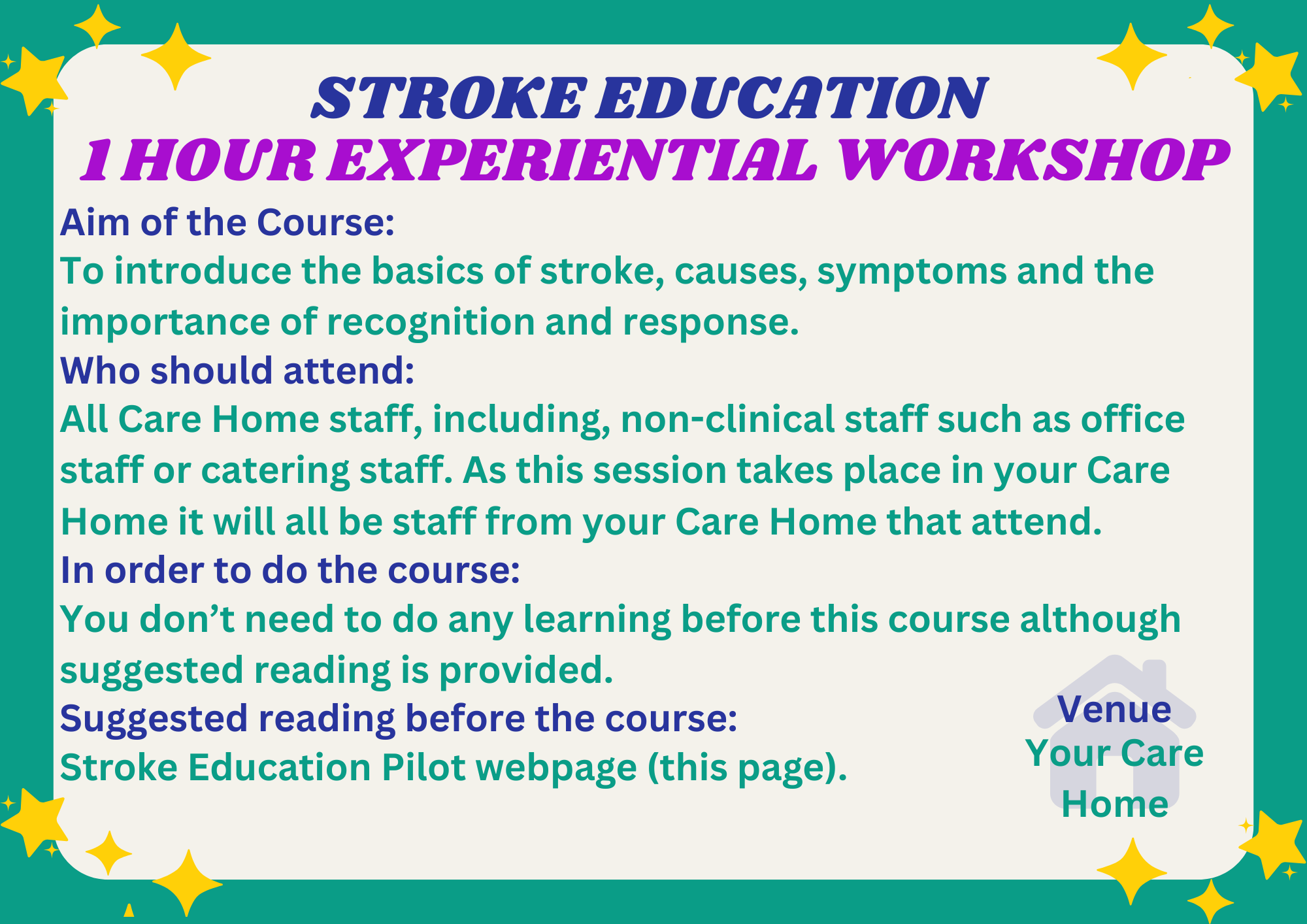
More information on the 1 Hour Experiential Workshop
This session will cover introductory information relating to stroke and aims to ensure all Care Home staff have a foundation of stroke knowledge.
It will include discussion and an experiential element so that learners can explore what it might feel like to have a stroke.
You will receive a certificate of attendance following this 1 hour experiential workshop.
Learning Aims and Objectives
Suggested Reading
- Materials on this webpage
Dates of Sessions
August
- Tuesday 4th August
- Wednesday 5th August
Thursday 6th August- Wednesday 12th August
Thursday 13th August- Monday 17th August
- Wednesday 19th August
September
- Tuesday 1st September
- Wednesday 2nd September
- Tuesday 8th September
- Wednesday 9th September
- Thursday 10th September
- Tuesday 29th September
- Wednesday 30th September
October
- Tuesday 6th October
- Wednesday 7th October
- Thursday 8th October
- Monday 19th October
- Monday 26th October
- Wednesday 28th October
- November
- Tuesday 3rd November
- Thursday 5th November
- Wednesday 25th November
- Thursday 26th November
New dates will be added in due course
If you cannot manage any of the dates available we can take a note of your Care Home and put you on a list for new dates/cancellations.
How to book or Express an Interest
Please email the Stroke Education Facilitator if you are interested in a session or want to know more.
This needs to be done by the manager or deputy manager of the Care Home as the sessions take place in the Care Home.
Email: stroke.trainer@nhs.scot
All Day
Carers Stroke Workshop
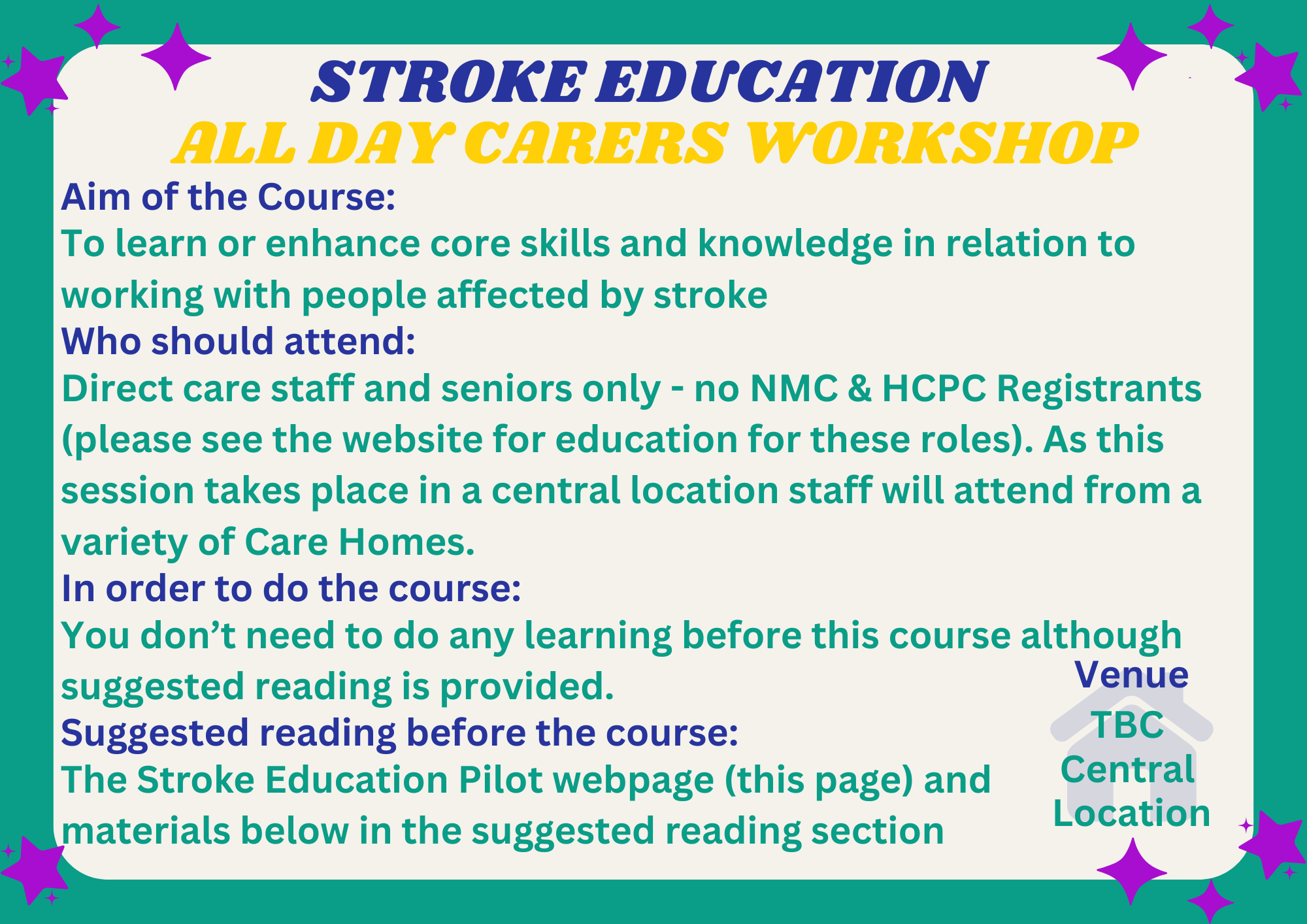
More information on the All Day Carers Workshop
This session will cover in-depth information relating to stroke.
It will include discussion and an experiential element so that learners can explore what it might feel like to have a stroke.
You will receive a certificate of attendance following this all day workshop.
Please note that this session is not offered (at this time) to NMC and HCPC registrants as we discovered in the development of the session that a lot of the material in the session was dupliction to learning already carried out during training for registration, which could be a little frustrating for participants.
Learning Aims and Objectives
Suggested Reading
- Materials on this webpage
- STARs Core Competencies
- Emotion Matters module on Turas – Turas is free to sign up to and everyone can get a login
- What is turas and how to log in
Dates of sessions
Wednesday 4th November 2026 Time: 9:00 – 16:00
16 Places Available
Venue:
Longstone Resource Centre
62 Longstone Street
Edinburgh
Midlothian
EH14 2DA
Further workshop dates to follow
How to book or Express an Interest
To book, register an interest or for more information, please ask your manager or deputy manager to email the Stroke Education Facilitator.
Email: stroke.trainer@nhs.scot
Other Education Available
There are other stroke education courses available, please see this article for education courses run by the NHS Stroke Team.
This article offers other useful educaitonal opportunities available on Turas. Turas is free to sign up to and everyone can get a login
What is Turas and how to log in
TURAS is a digital learning platform developed by National Education Scotland (NES) to provide a wide range of online educational resources for staff working in health and social care.
Turas is free to sign up for, and everyone can get a login.

Other Useful Resources
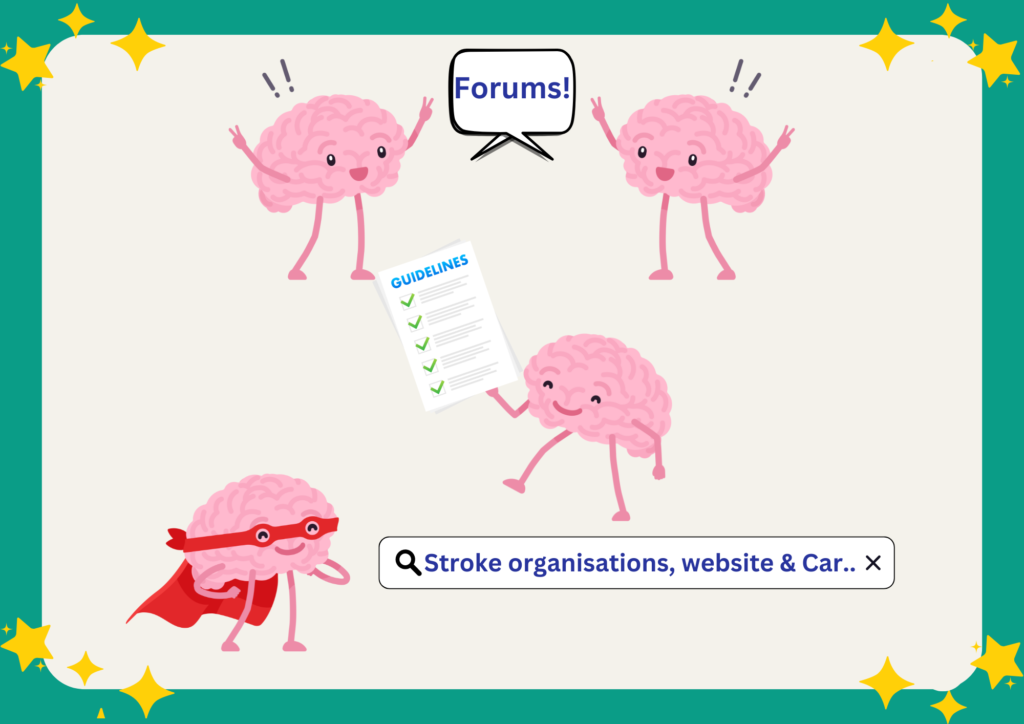
Please check out this document to find further resources on:
- Forums staff can attend
- National Guidelines
- Stroke websites and organisations, including carer support
Contact us
Thank you for reading this page, and if you have any questions or comments relating to the materials on this page, please do not hesitate to contact us at: stroke.trainer@nhs.scot
Please note this is to contact us about staff education on stroke – we cannot discuss any care needs with individuals or relatives as we are not that department.
Last Updated May 2026 TJ & HS